SolarStack
A three-dimensional solar panel
The core idea was a “3D solar panel”: capture more light at a given moment in order to generate more power.
The problem
Solar panels capture light along a 2D plane and are limited by insolation, the power per area given off by the sun or any light source. Insolation is fixed. The sun’s insolation is about 1040 W/m². Even a 100% efficient panel can never generate more than that.
But photons don’t travel in two dimensions; they travel through space in three. If we could take advantage of that, we could in principle generate more energy from a smaller surface area.
The proposal
The first obstacle is that a panel turned parallel to a ray of light absorbs none of it, so the light has to be redirected perpendicular to the cell. Devices like iPads and Kindles already do this in their backlights. A backlight is a light-guide plate (LGP) with LEDs only along its edges. The guide turns that edge light 90° and emits it from its face, which is the white glow you see on startup. What if we used a light guide for sunlight?
Some sunlight gets into the guide unaided, but it’s better to concentrate it onto the edge. We used linear cylindrical lenses: where a magnifying glass focuses light to a point, these focus it to a line.
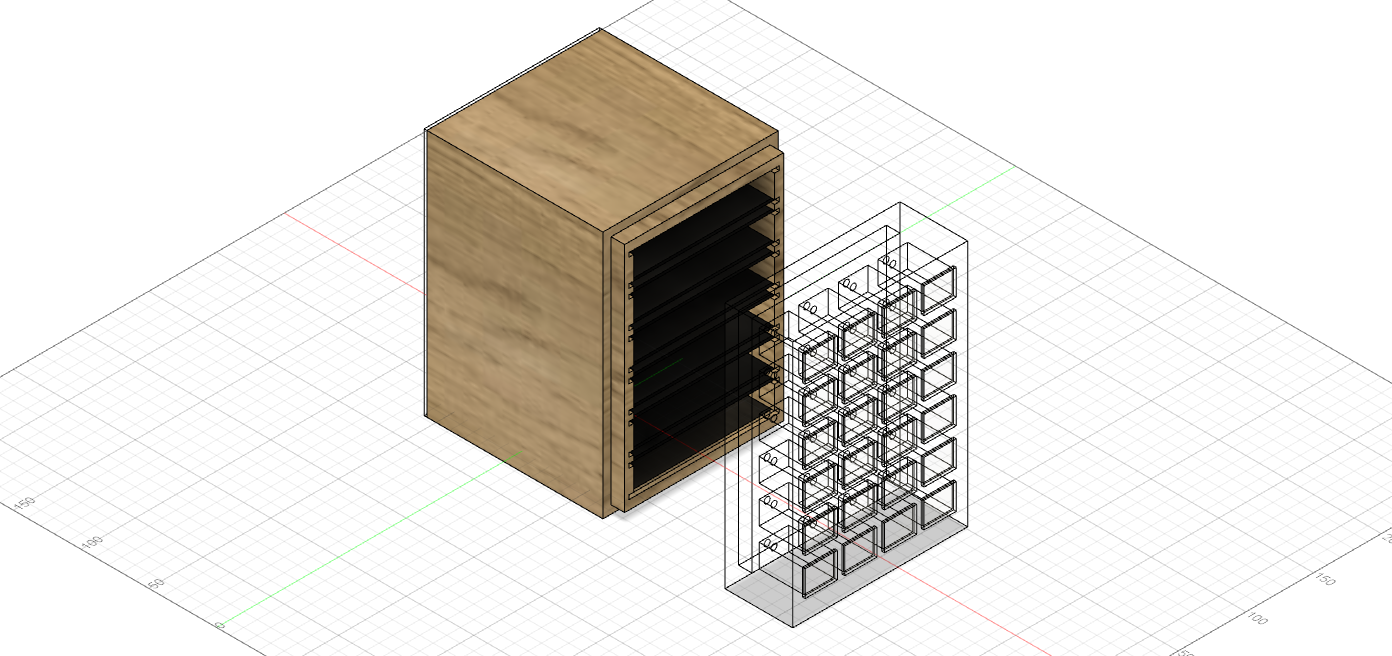
Finally, an enclosure holds everything together. For the experiment we compared a single flat control panel against a stack, with the control’s surface area matched to the area of the lenses, so we could see which generated more power.
Analysis
The device works, but not as well as hoped. It didn’t generate more raw energy than the control panel. Divide by area exposed to the sun, though, and the stack wins on what we called energy density.
Power from a cell is current times voltage, P = IV. A flat panel exposes more area, so naturally produces more raw power; energy density normalizes for that. These tests used no Fresnel lens; the guide edge faced the sun directly. Groups: a plain control cell, a 3mm LGP, and a 5mm LGP. The 5mm group averaged a 72.8% increase in energy density over the control.
Thinner guides did better still: the 3mm LGP reached roughly 121% higher energy density than the control. Encouraging, in that small optimizations yield surprising gains; discouraging, in that the densities we hoped for still look far off.
The major issue was the light guides themselves. Most came from overseas suppliers and were designed for white LEDs, which differ from sunlight in spectrum, luminosity and intensity. Most were also larger than the cells, so even a perfect guide would lose light. A few custom LGPs were designed, but their efficacy is hard to evaluate with home lab equipment. Worst, they weren’t remotely efficient. Moving a photosensor along an LGP’s length showed a steep drop-off in emitted light, so the cells were only partially lit, which hurts more than uniformly dim light because cell output falls nonlinearly with uneven illumination.
Conclusion
There are efficiency gains left on the table if cell designers add optical elements and consider orientations other than flat toward the sun. Purpose-built LGPs, better materials and cell selection could all help, possibly even housing for perovskite cells. By one estimate, matching a flat panel’s output would take about 20 cells and 10 LGPs, which is not a worthwhile investment yet. Commercial viability, though, is still far off and uncertain.
Still, the prototype shows what a little clever optical design can do, and points to a research path other than the materials-science race for ever more efficient cells. The full detail is in the patent, US 11,929,707 B2.